

Bohemian Wall Art: Collected, Not Matched
Do not buy this wall in an afternoon. Start with an anchor you love, leave honest gaps, and let finds with real stories finish it over months.
Key Takeaways
- Build in passes: one substantial anchor first, then three to five medium pieces hung close with mismatched frames, then small finds tucked into gaps — and photograph the wall before each addition to judge balance cold.
- Keep earth first and jewel second: terracotta, clay, sand, and faded greens as the weather, with saffron, teal, burgundy, or indigo appearing only as events.
- Mix media on purpose — prints beside textiles, mirrors, and woven hangings — unified by palette and closeness, not matching frames; if the wall looks too tidy, add something without corners.
- Repeat one home-note color, often terracotta or deep teal, quietly in most pieces; remove that thread and the same collection falls apart into unrelated objects.
- Edit harder, not less: every piece should earn its place by being loved, with darkest and lightest pieces distributed and a clear place for the eye to rest.
Most decorating styles begin with a plan. Bohemian style begins with a life. Its walls are not composed in a single weekend; they accumulate — a print from a trip, a textile picked up at a market, a poster kept since college, a painting by a friend. Bohemian wall art is the art layer of that accumulation: layered, traveled, and personal, arranged so the wall reads as collected rather than matched. The paradox at the style’s center is that this unplanned look still obeys rules — they are just rules about balance and editing rather than symmetry and sets. Bohemian is one of the sixteen styles surveyed in this series’ plain-language field guide to wall art styles.
If you are starting from a bare wall, do not buy the whole wall at once. Bohemian walls that convince are built in passes, over months, as pieces with actual stories arrive. Start with one or two anchors you genuinely love, leave honest gaps, and let the wall finish itself slowly. A bohemian wall bought complete in an afternoon usually reads as a costume of the style rather than the thing itself.
The bohemian wall art palette: earth first, jewel second
Bohemian color starts from the ground: terracotta, clay, sand, ochre, warm browns, and the faded greens of plants and old paint. Onto that earthy base the style layers its accents — saffron, deep teal, burgundy, indigo, the dusty rose of old textiles. The art you choose should live mostly in that earthy register, with the jewel tones appearing as events rather than as the whole weather. A wall where every piece shouts saffron and teal stops looking traveled and starts looking themed.
Age is part of the palette. Faded, sun-softened, and slightly imperfect images suit the style better than crisp, saturated ones; a print that looks as though it has already hung somewhere sunny for a decade belongs here in a way a glossy new poster does not. That is why vintage travel imagery, old botanical plates, folk patterns, and hand-drawn maps recur on bohemian walls — they arrive pre-weathered, with the patina the style runs on.
Mixing media is the method
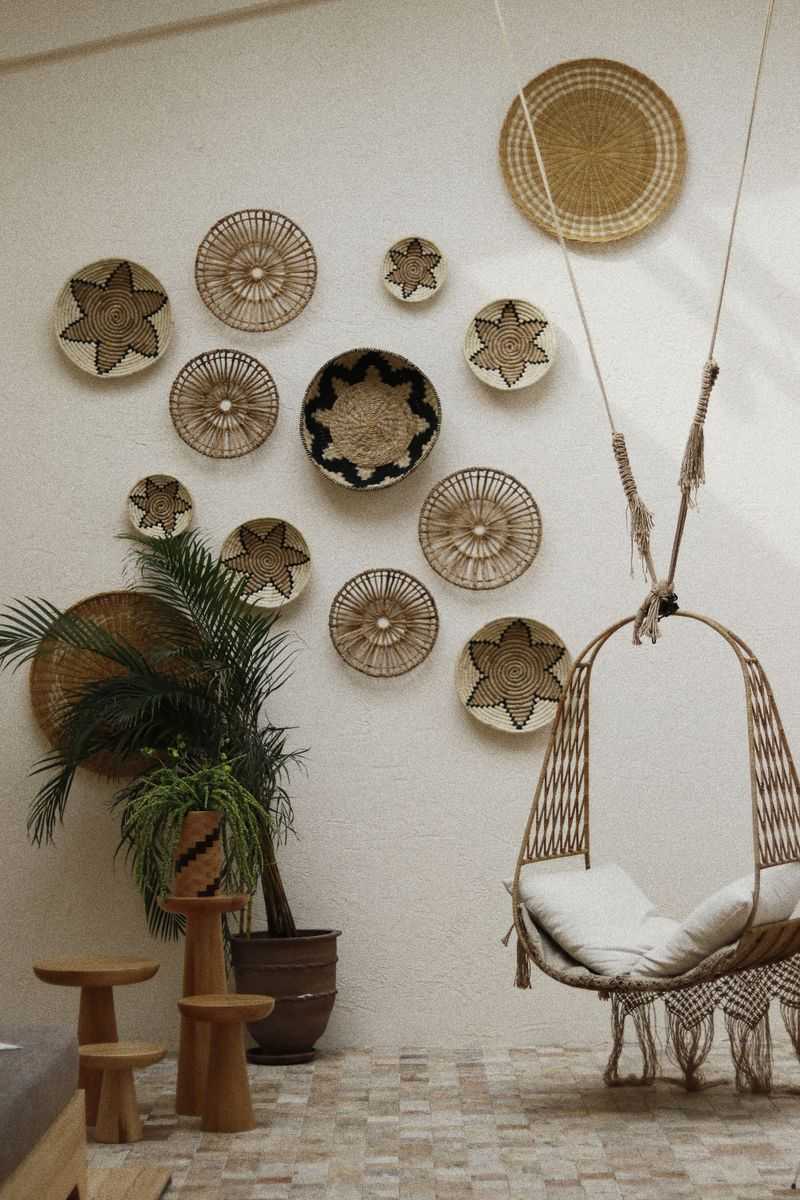
Where most styles unify the wall by framing everything alike, bohemian walls unify by the opposite route: variety held together by palette and density. Prints sit beside woven hangings, a small mirror leans near a photograph, a tapestry occupies the space a large painting would take elsewhere. The frames — when there are frames — mix freely: dark wood, rattan, thin metal, a clip instead of a frame at all. What keeps this from chaos is repetition of color and a consistent closeness: pieces hang nearer each other than in other styles, so the wall reads as one woven surface rather than separate islands.
Textiles deserve emphasis because they do double work. A hanging adds softness and slight movement that no print can, and it warms rooms whose walls feel hard. It also breaks the rectangle rhythm — a long textile beside square and landscape prints gives the arrangement its relaxed, un-gridded feel. If your wall looks too tidy, that is usually the missing ingredient: something without corners.
Bohemian wall art subjects that carry the stories
Bohemian subjects lean toward the gathered and the symbolic: sun and moon motifs, desert and jungle landscapes, arches and doorways, hands, eyes, feathers, and the flora of warm places. Travel imagery is the backbone — not glossy destination posters, but the textures of elsewhere: a Moroccan tile pattern, a Rajasthani miniature style, a West African textile design. A note of care belongs here: pieces drawn from living cultures read best when they are made by artists of those cultures or licensed from them, rather than imitations churned out by pattern mills. The style is about genuine gathering, and the wall can tell the difference between a souvenir and a costume.
Plants are the style’s unofficial eleventh piece. Trailing vines soften the top edge of an arrangement, and a plant’s shadow moving across a print through the day gives a still wall a kind of animation. When you plan a bohemian wall, leave a place where green can join it — a shelf edge, a hook, a gap at the corner — because the arrangement is not finished until something living is part of it — and walls that want the green as the subject rather than the accent, gardens and wildflower meadows in soft light, will find them in the cottagecore wall art guide.
Building in passes: a working sequence
Because the style accumulates, it helps to think of the wall in passes rather than as a project with an end date. Pass one is the anchor: one substantial piece — a large print, a textile, a woven hanging — placed where the arrangement will center, with everything else left for later. Live with the anchor alone for a while; it will tell you what it wants beside it, in color, in scale, and in mood. Pass two adds the middle register: three to five medium pieces gathered loosely around the anchor, hung closer than feels proper in other styles, frames mismatched, bottoms unaligned. Pass three is the small finds — the postcard-sized print, the tiny plate, the photograph — tucked into the gaps that remain, and it is the pass that never really finishes.
Two practical habits keep the passes coherent. Photograph the wall before each addition and study the photograph rather than the wall; the camera flattens sentiment and shows you the balance cold. And keep one color — the arrangement’s home note, often terracotta or deep teal — reappearing in most pieces, however quietly. That repeated note is the invisible thread; remove it and the same collection can fall apart into unrelated objects that happen to share a wall.
Renters and small rooms, take heart: this is one of the most forgiving styles at modest scale. Because its pieces are small, mixed, and hung close, a bohemian arrangement can live on a single short wall, above a desk, or around a window, and it tolerates the lightweight hanging methods that leases demand better than styles built on one heavy, perfectly centered piece. The wall’s charm is in its density of care, not its acreage.
The bedroom is its home ground
Bohemian art works in any room, but the bedroom is where the style’s logic — softness, layering, the personal — is the room’s logic too. Above a bed dressed in mixed linens, a loose arrangement of small prints, a textile, and one larger anchor piece mirrors the bedding’s own gathered quality. Keep the pieces nearest the bed the calmest in the arrangement: faces in warm detail are fine across the room, but the wall you fall asleep facing should drift toward landscape, pattern, and celestial motifs rather than portraits that hold your eye.
In living rooms the same approach scales up: one wall given fully to the layered arrangement, the others left comparatively quiet, so the room has a hearth and the eye has a home base. Hallways and reading corners take the style beautifully at small scale — three or four pieces and a plant can turn a pass-through into a place.
Editing: the rule inside the freedom
The difference between collected and cluttered is editing, and bohemian walls need more of it, not less. The working tests: does every piece earn its place by being loved, or is some of it there because the wall had a gap? Does the eye move across the arrangement and rest somewhere, or does it slide off, finding no anchor? Are the darkest and lightest pieces distributed, or clumped in one corner? Rearranging costs nothing but an afternoon, and the style expects it — walls that evolve as pieces arrive, leave, and move rooms are the authentic article.
When you add to a collection of bohemian wall art, browse widely across subjects and styles rather than hunting for a bohemian-labeled set; the style is an act of mixing, and its best pieces often file themselves under landscapes, botanicals, abstracts, and vintage. Choose the next piece the way the first ones were chosen — because it stopped you — and let the wall stay what it was always meant to be: the visible record of a life being lived in the room, one find at a time.
More in Style Guides
Continue exploring: Style Guides guides · All guides