

Kids' Room Wall Art That Grows With Them
Interests will change on a schedule, so keep the current obsession in bedding and posters — and hang the lasting subjects where a child can actually see them.
Key Takeaways
- Safety comes before style: use fixings rated well beyond the piece's weight, two points instead of a swinging wire, light pieces over the bed, and acrylic rather than glass if a frame is glazed.
- Hang main pieces at the child's eye level — a centre around 36 to 44 inches depending on age — not the adult 57- to 60-inch standard, and re-hang higher as they grow.
- Choose long-life subjects such as animals, maps, landscapes and the night sky, which stay interesting as a child's reading of them deepens.
- Let the child make the final call from three or four pieces you have already approved for safety, size and sanity, and always leave space for their own artwork.
- Design for change in two layers: a few well-made keeper pieces underneath, and a disposable top layer of ledge prints, clipped pieces and removable peels for the current phase.
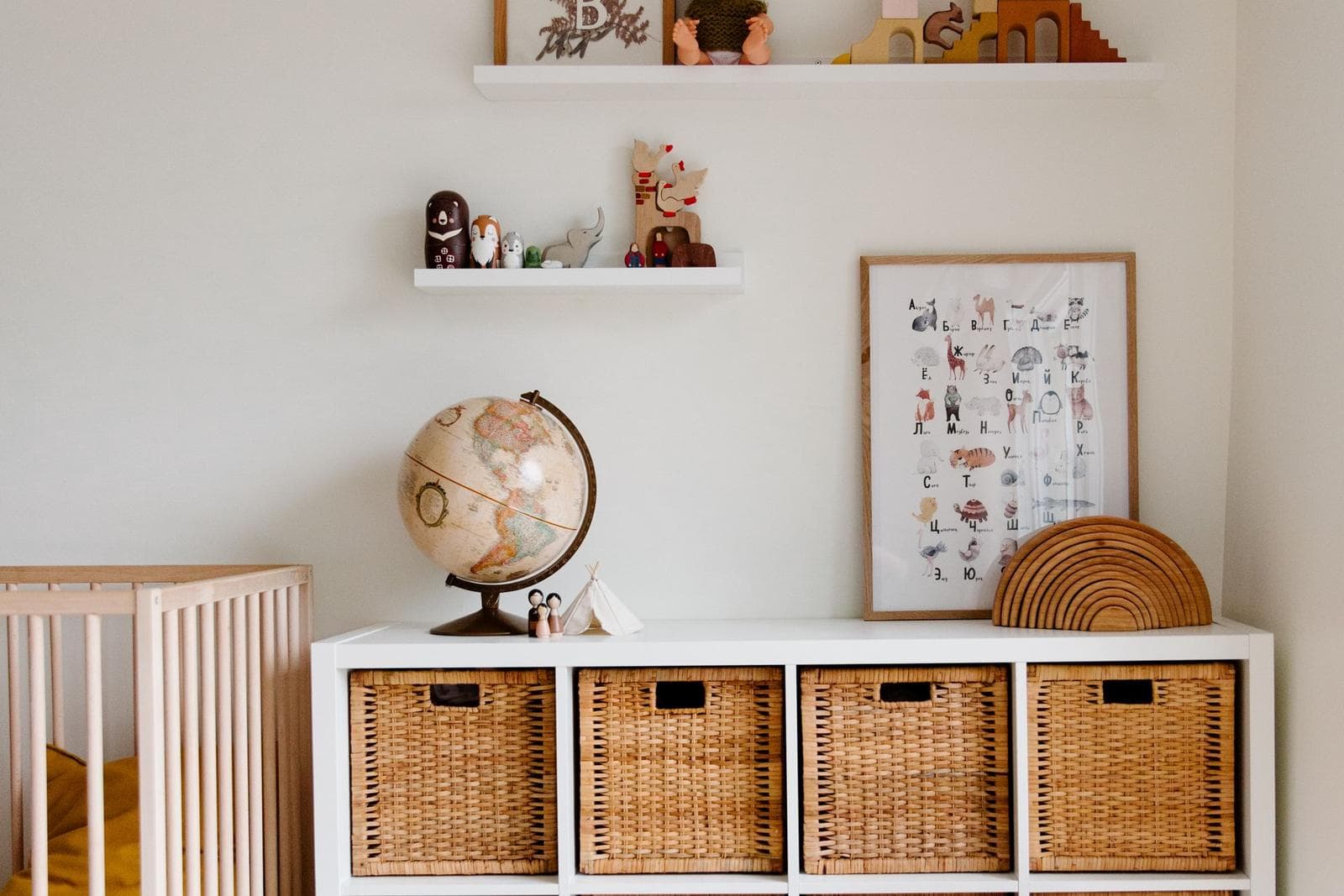
A kids’ room is the fastest-changing interior in the house. Its occupant goes from stacking rings to chapter books to strong opinions about everything in what feels like a single season, and the walls are expected to keep up. The art that works here is chosen on three principles that adult rooms never have to think about: it must be safe at grabbing height, it must be easy to change without a renovation, and some of it, at least, should be able to grow up alongside its owner. For the browse view, see kids’ room wall art; this guide covers safe hanging, hanging at their height rather than yours, and how to let children choose without surrendering the room to chaos.
Safety is the first design decision
In an adult room, hanging is a question of level and height. In a kids’ room it is a question of physics and curiosity. Anything within reach will eventually be touched, leaned on, and tested, so hang as if the piece will be pulled at: fixings rated well beyond the piece’s weight, two fixing points rather than a swinging wire, and closed hangers that cannot be lifted off a hook by an experimental tug. Over the bed and in play zones, favor light pieces — a canvas or a paper print is a featherweight compared with a glazed frame of the same size — and if a frame is glazed, acrylic glazing is the forgiving choice in a room where things get thrown. Nothing heavy and nothing glass-fronted belongs above a pillow, in this room above all.
Revisit the hanging as the child grows. The piece that was safely out of reach at two is at shoulder height at six, and the toddler who ignored it has become the kid who uses the bed as a launchpad. A yearly walk-around with fresh eyes — what can be reached, bumped, climbed to — is the whole of the maintenance regime, and it takes five minutes.
The door deserves a thought in this audit. Kids’ room doors are opened at speed, by small people carrying large objects, and a piece hung where the swinging door’s handle travels will eventually meet it. Behind-the-door wall space is tempting and almost always a mistake in this room; spend it on a hook rail or nothing at all, and keep the art where the room’s traffic cannot argue with it.
Hang it at their height, not yours
Adult art hangs at adult eye level, 57 to 60 inches to the center, and in a kids’ room that puts the art in a different country from its audience. Hang the main pieces for the person who lives there: a center around 36 to 44 inches from the floor, depending on the child’s age, puts art where it is actually looked at — at bed height for stories, at standing height for a young child’s wandering eye. Low-hung art also does quiet developmental work: pictures at a child’s own level are examined, narrated, and remembered in a way that art near the ceiling never is.
Expect the art to migrate upward over the years, and treat that as a feature. The same pieces, re-hung a foot higher, mark a growth spurt in the room as surely as pencil marks on a doorframe. Keep one grouping low even as they grow — a reading corner arrangement at seated-on-the-floor height stays relevant long after the toddler years.
Kids’ room wall art subjects they can grow into
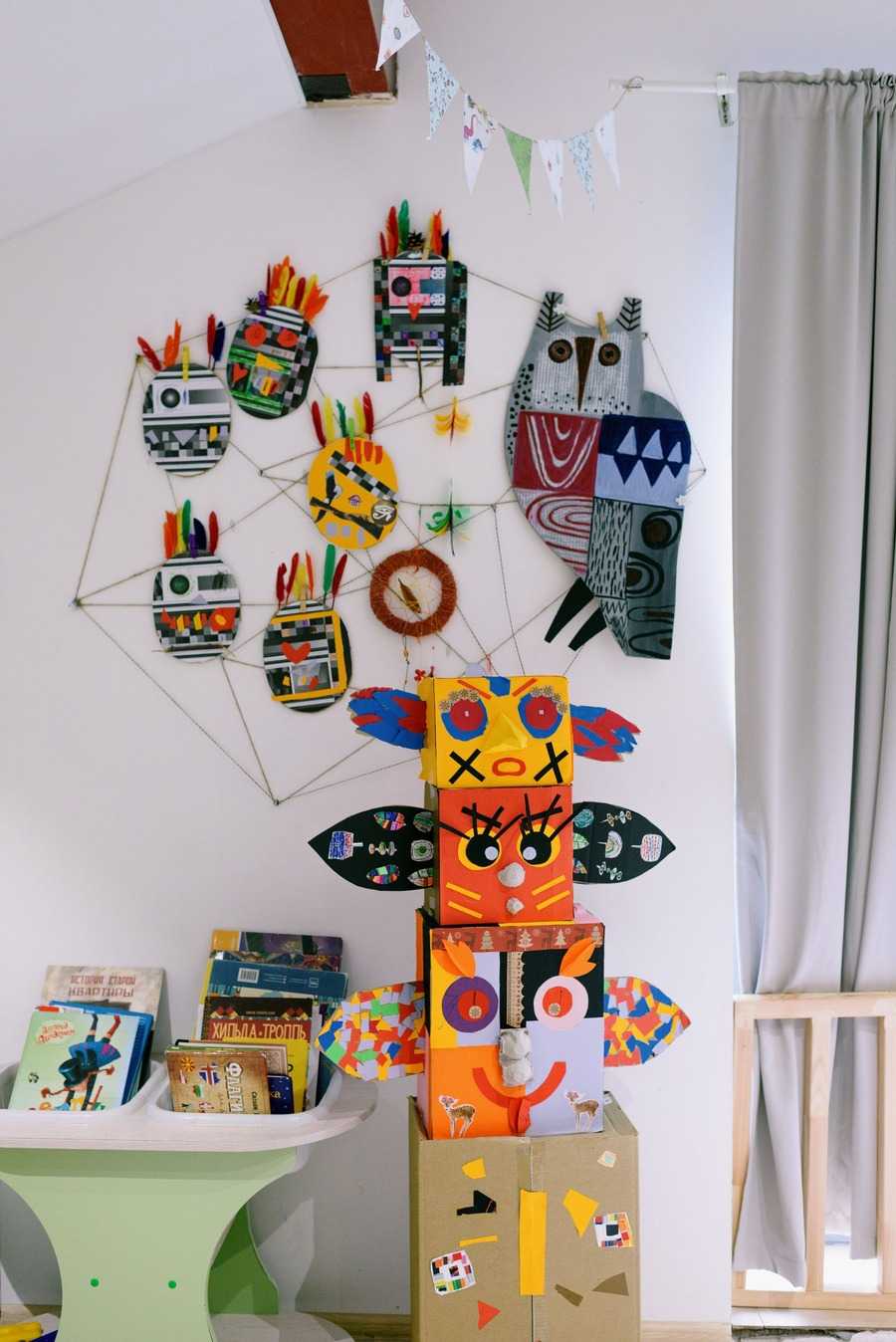
The subjects with the longest shelf life share a quality: they are real things, interesting at four and still respectable at fourteen. Animal wall art leads the list. A good animal portrait is a companion to a small child — someone in the room with them — and a piece of natural history to an older one; the same elephant works in both rooms because the child’s reading of it deepens rather than expires — the staying power of animal portraits with presence. Maps run the same long race: a world map is a picture of shapes and animals at five, a geography lesson at nine, and a promise at fifteen. Landscapes, the night sky, ships and the sea — the classic childhood subjects earned that status by outlasting the phases around them.
The short-shelf-life subjects are the licensed and the literal: whatever character currently rules the playground will be an embarrassment on a fixed schedule, and it will date the whole room with it. Keep the current obsession in the changeable layers — bedding, cushions, the poster that tapes up and comes down — and keep the hung art for subjects with a longer lease.
Whimsy with a long shelf life
Playfulness itself does not expire; only its vocabulary changes. Art in the whimsical style — a bear with an umbrella, a whale carrying a garden, maps with sea monsters in the margins — walks the line beautifully: it is unmistakably for a child, but it is made with enough wit and craft that it does not become babyish. The test is the adult test, oddly: if a piece makes you smile rather than merely approve, it has the wit to last. Whimsy also licenses color. A kids’ room can carry the saturated, joyful palette that a living room would flinch at, and a few bright pieces against calm walls give the room its energy without painting every surface a primary color.
Two children, one room
Shared rooms add a diplomacy problem to the design problem, and the walls are where it gets solved. Give each child a territory: a pair of pieces over each bed, or one side of the room each, chosen by its occupant inside the usual fence. Symmetry in the furniture with asymmetry in the art — same size, same frames, different beloved subjects — reads as a deliberate peace treaty: the room stays composed while each child’s allegiance is visibly honored. Shared walls, like the one by the door or above a common dresser, take the household’s neutral pieces: the map, the landscape, the animal nobody owns. When one child moves out or up a size, their territory is what changes; the room’s bones and its keepers carry on, which softens a transition that is rarely only about furniture.
A note on color: bright art, calm walls
The decorating instinct for kids’ rooms runs to painted color everywhere, and it fights the room’s other job, which is sleep. The division that works: calm walls, joyful art. Pale, restful wall color keeps the room’s volume down at bedtime, while the art — saturated, funny, full of animals and weather — carries all the energy in doses the eye can choose to visit. When the palette of the art changes with a new phase, a pillow and a throw follow it for the price of an afternoon, and the walls never need repainting. Art-led color is also the renter’s and the commitment-phobe’s friend, in kids’ rooms and every other kind.
Let them choose their kids’ room wall art (inside a fence)
Children who choose their own art live differently with it — they show it to visitors, they weave it into games, and they noticeably break less of it. The workable method is the bounded choice: you do the narrowing to three or four pieces that pass your tests of safety, size, and sanity, and the child makes the final call. The narrower the fence and the younger the child, the better this works; a teenager’s fence can be a budget and a size, and nothing else.
Leave wall space, always, for the art the child makes. A rotation of their own drawings and paintings, framed or on a line, hung in the same company as the bought pieces, does something no purchased art can: it tells the room’s occupant that their work belongs on walls. Keep the frame sizes standard so the rotation is a two-minute swap, and retire retiring masterpieces to a folder rather than the bin — the archive becomes a treasure with a speed that will surprise you.
Plan for the change, not against it
Accept the turnover and design your kids’ room wall art for it. The bottom layer of the room’s art — the keepers — is a few well-chosen pieces in the long-life subjects, framed or formatted well enough to move up the wall and, eventually, to another room. The top layer is deliberately disposable: prints on a ledge, pieces taped or clipped, the current passion at its current size, and removable wall peels for changing minds belong in that same easy-change layer. When the phase changes, an afternoon refreshes the top layer while the keepers hold the room’s continuity. The result is a room that never has to be redecorated, only re-hung — and a child who has watched art being chosen, hung, and kept learns to do it for every room they live in afterward. The stage before this one has its own version of the same thinking — gentle nursery wall art for the smallest room.
More in Room Guides
Continue exploring: Room Guides guides · All guides