

How-To: Sizing, Hanging & Arranging
How to Hang Heavy Pictures Safely
Heavy pieces pull outward as well as down, for years at a time. Weigh the piece, find what the wall is made of, and spread the load instead of trusting one fixing.

Key Takeaways
- Treat anything much over 20 pounds as heavy: weigh it on a bathroom scale by subtracting your weight without the piece from your weight holding it, and write the number on the back of the frame.
- Find the studs first — most stand 16 inches apart, center to center — using a stud finder, a strong magnet over the drywall screws, or the knock test, and check for cables and pipes before drilling.
- Spread the load across two fixing points spaced wide apart, hanging each D-ring on its own anchored hook rather than strung on a wire, which pulls the rings inward and bows the piece outward.
- Between studs, use heavy-duty anchors that spread load behind the board, like toggle bolts, in pairs and within the maker's ratings — and never trust crumbling or water-damaged drywall.
- For the biggest pieces, a French cleat wins: a 48-inch wall rail in a 16-inch-spaced wall can be screwed into as many as four studs, and the piece can slide on the rail for final centering.
Hanging a heavy piece is a different job from hanging a light one, and the difference is not just effort. A small frame asks a wall for a little downward support; a large, glass-fronted, or solid-backed piece pulls outward as well as down, and it keeps pulling, every hour of every day, for years. Hardware that feels solid on day one can creep, tilt, and eventually let go if the load was never properly understood. The good news is that how to hang heavy pictures is a solved problem: weigh the piece, learn your wall, spread the load, and the physics works for you instead of against you.
How to hang heavy pictures: start by weighing the piece
Guesses are how heavy art gets under-hung. “It feels like about thirty pounds” is not a number to buy hardware against, so get a real one. The simplest method needs only a bathroom scale: weigh yourself holding the piece, then weigh yourself without it, and subtract. If the scale reads 196 pounds with the frame in your arms and 170 without, the piece weighs 26 pounds — write it on the back in pencil, along with the date, so the next person who hangs it starts from fact instead of feel. Framed pieces with glass and solid backing regularly weigh far more than their size suggests, and the weight — not the dimensions — is what chooses your fixings. Choosing those dimensions in the first place — how big the piece should be for its wall — is the job of our guide to wall art sizes.
As a working line, treat anything much over 20 pounds as heavy for hanging purposes: below that, ordinary picture hooks on sound drywall are a reasonable conversation; above it, you are choosing anchors, studs, and load-spreading on purpose. The large and oversized end of any catalog lives almost entirely above that line. Each of those fixings — D-rings, wire, cleats, and anchors — is decoded in the picture hanging hardware guide.
Know what your wall is made of
The wall matters more than the hook. In a typical framed house, the strongest thing behind the paint is a stud — vertical framing timber, most often spaced 16 inches apart, center to center. A screw driven into a stud is held by solid wood; a fixing between studs is held only by the wallboard itself, which is why drywall anchors exist and why their ratings assume sound, undamaged board. Find your studs before you decide anything: an electronic stud finder is the direct route, a strong magnet dragged slowly across the wall will catch the drywall screws along a stud line, and a knock that changes from hollow to flat is the oldest test of all. Once you find one stud, measure 16 inches to either side and test again — the next one should be there.
Plaster walls in older homes hide lath instead of board, and their stud spacing is less predictable; hanging art on brick, plaster, and concrete is a different discipline again. Hardware guidance also assumes you have checked what runs inside the wall: electrical cable and plumbing often travel vertically and horizontally from outlets and fixtures, and no picture is worth drilling into either. When a wall’s construction is genuinely unknown, that uncertainty is itself information — it argues for the most conservative method, or for a professional.
Spread the load: two points beat one
A heavy piece hung from a single central point concentrates everything — weight, leverage, and any tendency to swing — on one fixing. Two fixing points, spaced wide apart, halve the argument each one has to win and keep the piece level without constant adjustment. This is why substantial frames carry two D-rings, one on each side rail, meant to hang from two separate hooks rather than from a wire strung between them. A wire changes the forces: it pulls the rings inward and adds an outward bow, and the longer and slacker the wire, the more the whole arrangement wants to lean away from the wall. For genuinely heavy work, hang each ring on its own anchored hook, level them once, and the piece stays where you put it.
Whatever anchors you choose, choose them by the wall and the weight together, and leave margin. Anchor ratings vary by maker, by wall material, and by the condition of the specific patch of wall you drill — treat any printed rating as a ceiling under ideal conditions, not a promise, and buy comfortably above your piece’s measured weight rather than exactly at it.
When no stud is where you need one
Sometimes the right position for a piece falls between studs, and moving a large work eight inches to find timber ruins the composition it was hung to make. That is the honest use case for heavy-duty drywall anchors — the kind that spread the load behind the board rather than gripping the board’s thickness. Toggle bolts pass a spring-loaded wing through the hole and pull it flat against the back of the drywall; strap and molly-style anchors expand or set a sleeve the same way. What they all share is area: instead of one screw’s worth of gypsum resisting the pull, a patch of board several inches across shares it. Used in pairs, in sound board, within their maker’s ratings and with the margin this guide keeps insisting on, they are a legitimate engineering answer. What they are not is a substitute for judgment about the board itself — crumbling, water-damaged, or previously perforated drywall has already told you its rating, and it is low. In board you do not trust, the choices narrow to finding a stud, bridging to two of them with a cleat or a mounting board, or choosing a different wall.
How to hang heavy pictures with French cleats
For the biggest pieces, the method professionals reach for is the French cleat: two long rails with matching 45-degree bevels, one screwed to the wall, one to the back of the piece, so the frame lowers onto the wall rail and gravity itself locks the joint. Its virtue is distribution. A 48-inch wall rail, positioned to start on a stud in a 16-inch-spaced wall, can be screwed into as many as four studs along its length — at 0, 16, 32, and 48 inches — so the load is shared by the wall’s frame instead of hanging off one patch of board. The piece can also slide a few inches left or right on the rail for final centering, and it lifts off cleanly for cleaning or repainting. Metal cleat systems rated for serious weight are sold for exactly this purpose; match the cleat’s rated capacity, with margin, to the number you wrote on the back of the frame.
The hang itself: two pairs of hands
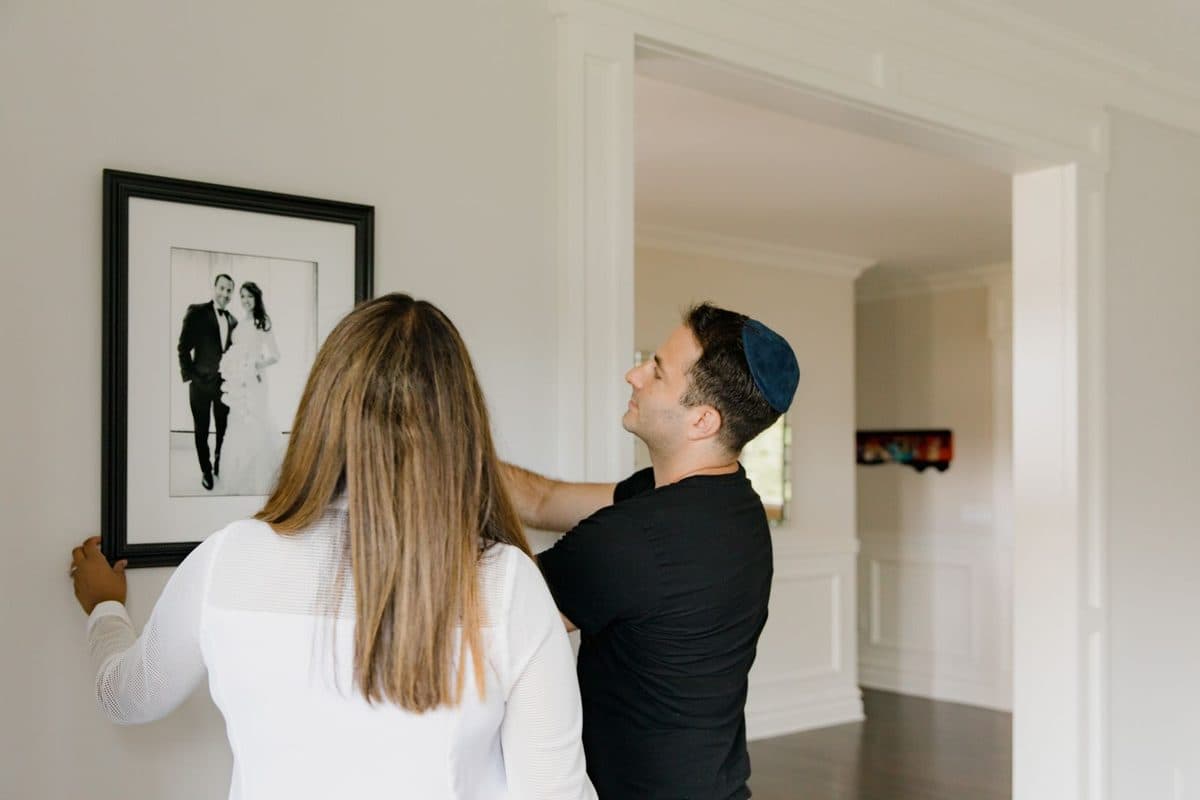
Mark before you drill: hold the piece (with your helper — heavy hanging is not a solo sport) against the wall, check the position at viewing distance, and mark the fixing points through the hardware rather than measuring from the frame’s top edge, which invites arithmetic errors. Pre-drill where the material wants it, keep the drill level, and test each anchor with a firm downward pull before the piece goes anywhere near it. Lift the piece onto its fixings together, on a count, with the bottom edge supported until the hardware takes the weight. Then step back, check level, and check again the next day — and after the first week, confirm nothing has shifted. Heavy pieces that are going to move usually announce it early, as a slow tilt or a widening gap at the top edge.
In a living room, where the largest pieces usually live above the largest furniture, also think about what is underneath: a heavy frame should never hang where a failure would land it on seating or a bed if there is any doubt about the wall. The conservative placement and the conservative fixing are the same instinct.
When to hire a professional hanger
Professional picture hangers exist, and some jobs are theirs: pieces too heavy or awkward for two people to lift safely, walls of masonry or unknown construction, valuable or fragile work you cannot afford to drop, and high placements — stairwells, double-height walls — that need ladders or scaffolding. Hiring one is not an admission of defeat; it is the same judgment as weighing the piece instead of guessing. Our frequently asked questions cover the ordering side of large pieces in principle, and the honest summary of how to hang heavy pictures fits in one line: measure the weight, respect the wall, spread the load, and the art will still be exactly where you left it in ten years.
More in How-To: Sizing, Hanging & Arranging


Continue exploring: How-To: Sizing, Hanging & Arranging guides · All guides