

Bedroom Wall Art Ideas for Restful Rooms
The audience here is horizontal, half-asleep and looking in low light — so pieces that feel calm at noon can still be the wrong choice by bedtime.
Key Takeaways
- Bedroom art has one job — help the room slow down — so filter for soft contrast, low energy and low complexity before choosing a subject.
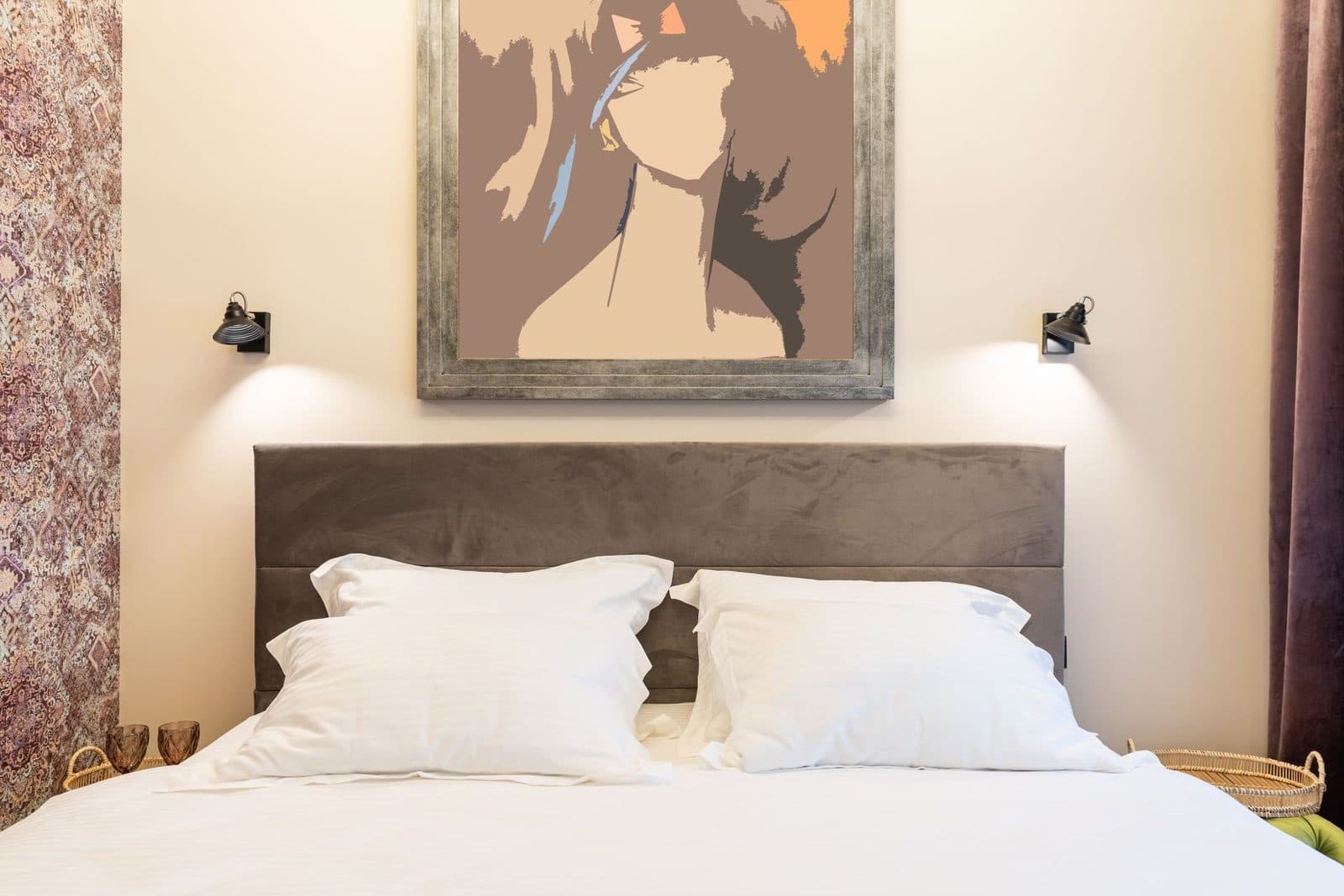
- Size art above the bed to roughly two-thirds to three-quarters of the bed or headboard width, and hang its bottom edge 6 to 8 inches above the headboard.
- Choose dusky blues, sage, warm neutrals or faded terracotta and test candidates in actual evening lamplight, because bedrooms are mostly seen in dim, warm light.
- Put the piece you like most on the wall opposite the bed — the one you actually wake up to — hung around 48 to 52 inches for someone sitting up.
- Use fixings rated well beyond the piece's weight, prefer two fixing points, and favour lighter formats for art hanging above sleeping people.
Every other room in the house asks art to perform — to welcome, to impress, to start conversations. The bedroom asks the opposite. Bedroom wall art ideas share one job: to help the room slow down. That single difference changes nearly every choice, from the subjects that work to the height of the wall they hang on. For the browse-by-room view, see bedroom wall art; this guide covers the reasoning — how to choose pieces that keep the room restful instead of quietly waking it up.
The most common bedroom mistake is importing living room wall art ideas wholesale: a bold statement piece, high contrast, hung for a standing audience. In a bedroom the audience is horizontal, half-asleep, and looking at the art in low light for long stretches. Pieces that pass that test feel inevitable. Pieces that fail it are the ones people describe, months later, as “never quite relaxing in there” without knowing why.
The bedroom brief: lower the volume
Start with three filters that suit almost every bedroom. First, contrast: soft edges and gentle tonal steps rest the eye, while hard contrasts — stark black against white, saturated complementary colors — ask the eye to keep working. Second, energy: subjects in motion (breaking waves, city traffic, galloping anything) carry a pulse that works against the room. Third, complexity: the more small detail a piece asks you to resolve, the more awake it keeps a tired brain. None of this means bland. A bedroom piece can be large, dark-toned, and full of character; it just needs to hold its character quietly.
A practical test: imagine the piece as the last thing you see before sleep and the first thing you see on waking, in gray morning light, every day for five years. Art that survives that thought experiment is bedroom art. Art that would start to shout by February is for another room.
Bedroom wall art ideas that soothe
The classic bedroom subjects share a quality of distance — scenes the eye can wander into without meeting anything that demands a response. Landscapes lead the list: misty hills, calm water, open fields, and shorelines at low tide all read as depth and quiet, and a soft horizon is about the most restful line in art. Botanical studies run a close second — a pair of leaf or fern studies brings the garden indoors without a single bright petal competing for attention. Photography of fog, dunes, and still water belongs in the same family, as do quiet abstracts whose color does the work a scene would otherwise do.
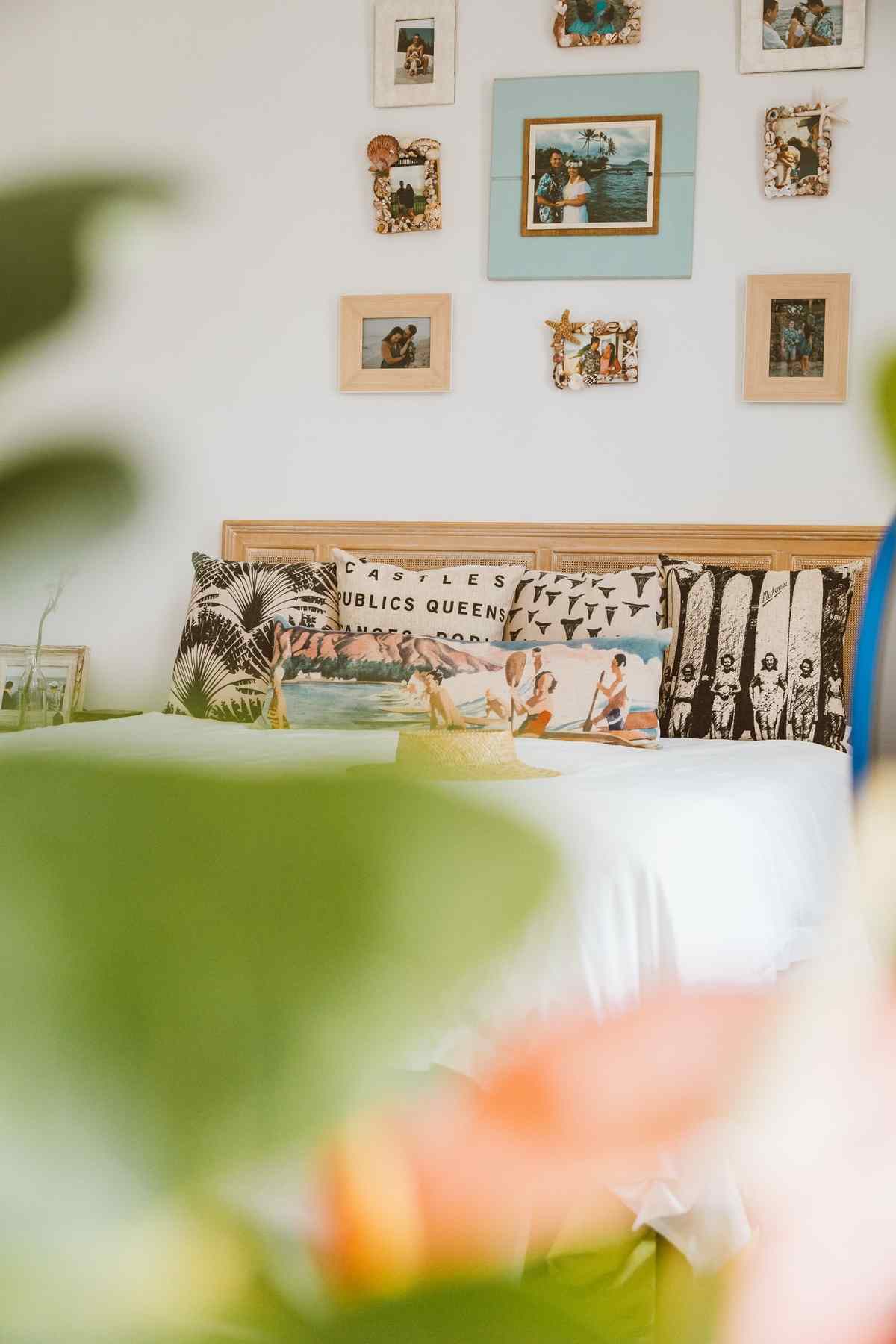
Two cautions. Large faces directly above the bed — portraits at statement scale — make many sleepers feel watched; if you love portraiture, give it a side wall at a modest size. And busy pattern, however pretty, is visual noise at bedtime: dense geometrics and collage belong where people are awake to enjoy them.
Color and light in a low-light room
Bedrooms live in dim, warm light for most of their occupied hours, and art should be chosen for that light, not for showroom daylight. Palettes that rest well: dusky blues and blue-grays, sage and eucalyptus greens, warm neutrals, clay and faded terracotta, ink softened to charcoal rather than black. Pure white mats and frames can glare under bedside lamps; warm off-white and natural wood tones sit more comfortably after dark — the wider question of art for neutral rooms: color, texture, or tone on tone has its own guide.
Match the art’s temperature to the room’s. A cool-toned piece in a warm, lamplit room turns gray and sullen; a warm-toned piece in a pale, north-facing room can glow pleasantly at night and look merely gentle by day — the safer direction of error. If you are choosing between two candidates, judge both under your actual evening light before you decide. Screens lie politely about this; a print sample or even a phone photo of the image held against the wall at lamp-light tells you more.
Sizing bedroom wall art ideas above the bed
The wall above the bed is the room’s main wall, and it obeys a version of the furniture rule: the art should span roughly two-thirds to three-quarters of the bed’s width, measured across the headboard if there is one. Run the numbers. A queen bed is 60 inches wide, so the art — or the pair, counted as one arrangement — should total about 40 to 45 inches across. A king at 76 inches wants 50 to 57 inches. A double at 54 inches wants 36 to 40. Narrower than that and the piece looks like it is floating above the pillows by accident; wider than the headboard and it starts to upstage the bed itself.
Height is about the gap, not the ceiling: the bottom edge of the art belongs 6 to 8 inches above the top of the headboard. If you have no headboard, hang so the bottom edge sits roughly 8 to 10 inches above the mattress line, keeping the piece visually tied to the bed rather than the wall. For pairs, split the total width across two pieces with a consistent 2- to 3-inch gap between them, and treat the pair as one rectangle that obeys the same totals. A pair of verticals is the classic bedroom solution for a reason: two calm images, symmetric over the pillows, read as one restful gesture.
Two variations on the rule are worth knowing. With a tall headboard or four-poster, measure from the top of the headboard itself rather than the bed: the art relates to whatever it hangs over. And where ceiling height allows, a multi-panel arrangement — three verticals marching across the bed’s width — can serve the same total span with more air in it, a good answer for wide, low headboards. The panels obey the same arithmetic: total width including gaps in the two-thirds to three-quarters band, bottom edges level and 6 to 8 inches above the headboard, gaps even. A triptych that looks scattered has almost always failed on the gaps, not the images.
The case for framed canvas here
Any format can work in a bedroom, but framed canvas earns a special mention. The thin float frame gives the piece a finished, deliberate edge — which suits a room with a made bed and matched lamps — while the canvas face stays matte, so there is no glass to catch the bedside lamp or the morning window. Paper prints under glass bring a crisper line and suit botanical studies beautifully, but place them on a wall that lamplight reaches at an angle rather than head-on. Whatever the format, keep one surface quality constant across the room’s art: mixing a glossy piece with matte ones splits the room’s light behavior and makes the glossy piece shout after dark.
The wall you actually wake up to
Decorating advice fixates on the wall above the bed, but you never see that wall — you face the opposite one. The wall across from the bed is your morning view, and it deserves the piece you like most: a single landscape with some depth, a series of small studies, or a shelf of rotating photographs. Keep its scale a step below the headboard wall so the room keeps a hierarchy, and hang its center near eye level for someone sitting up in bed — lower than the standing standard, around 48 to 52 inches from the floor.
The remaining walls take supporting roles. Above a dresser, a modest horizontal piece or a pair of small studies works, kept clear of the objects the dresser actually holds. In a reading corner, one small piece at chair height makes the corner a destination. Resist filling every wall: a bedroom with one or two calm walls and one or two empty ones feels larger and rests better than a room circled by art.
Sound belongs in the plan too, quietly. Hard, glossy surfaces — glass, acrylic, metal, bare plaster — bounce a room’s small noises back into it, while fabric-faced canvas and other soft surfaces absorb a little of them. In a bedroom on a busy street or in a house with thin walls, a large soft-faced piece is doing gentle acoustic work as well as visual work. It will not soundproof anything, but bedrooms are won and lost on accumulations of small calms, and this is one of them.
A note on weight, because it is above a bed
Art above a bed is art above sleeping people, so its hanging deserves one extra minute of care. Use fixings rated well beyond the piece’s weight, prefer two fixing points over a single wire where the piece is wide, and favor lighter formats for the largest sizes — one of canvas’s quiet advantages is how little it weighs for its dimensions. Check the hang once after the first week; new fixings settle, and a piece that has crept a quarter-inch out of level above a headboard will bother you at exactly the moment you are trying to fall asleep.
The bedroom order of operations
Bedroom wall art ideas in the right order: choose the mood first and let it filter subjects; keep the palette dusky and warm-light-tested; size the headboard wall by the two-thirds rule and hang it 6 to 8 inches above the headboard; give the wall you wake up to the piece you love best; and leave at least one wall empty. A bedroom decorated in that order does not just look restful — it behaves restfully, which is the whole point of the room. For the smallest room in the house, the same calm comes first — see gentle nursery wall art.
More in Room Guides
Continue exploring: Room Guides guides · All guides